| interpretation |
| Greil Marcus |
| When That Rough God Goes Riding |
| Listening To Van Morrison |
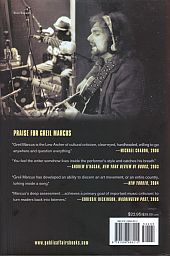


| publisher: PublicAffairs |
published: 2010-04 |
ISBN: 978-1-58648-821-5 |
| language: english |
format: hardcover |
pages: 188 |
dimensions (w*h*d)[mm]: 149 * 218 * 19 |
|
Review by saw
Marcus is one of those critics and music writers who 'discovered' Van before everyone else around the Astral Weeks time. Of course as long as that album never made the charts and a wider public they could promote him amongst their friends and in their writings as 'theirs'. As soon as Van became popular and known widely through Moondance, they could then say that he never did anything worthwhile because he had public acclamation. This has happened with so many artists. Early championing when unknown, then disdain when popular and so, in his eyes, not as 'good'. After all if the masses like an artist and buy his music, how could he be producing anything good? So I bet Marcus says that Van stopped producing anything worthwhile after ITLYSN, and didn't release a decent album until PCC.
This whole book smacks of the 'who shall I write about next' syndrome. 'I've done Dylan and the Band and Americana, etc, I know, I used to like Van so I'll write a book about his music, get a nice advance, and thank you very much'. Next, Bruce?
Review by Mikael Wood
At one point in his new study of the celebrated Irish musician Van Morrison, veteran cultural critic Greil Marcus describes a 1970 bootleg recording called "Caledonia Soul Music" and reflects, "Here Morrison is a bandleader, not a singer." Then he changes his mind and decides, "Really his role is as a conductor," before making one more tweak, concluding that "Caledonia Soul Music," in fact, posits Morrison as "a pathfinder."
Marcus can probably relate to that shifting sense of identity, for although he's best known as a writer, what he really is is a listener. In When That Rough God Goes Riding-bracketed by meditations on Morrison's recent live performances of his celebrated 1968 album Astral Weeks, which the author claims he's listened to more than any other record-Marcus subjects a series of Morrison's recordings to his signature close-reading treatment, hearing more in a single line or word than others do in entire iTunes libraries. A sample observation, made about the 1971 song "Friday's Child": "When Morrison sang it the song was its own wind; as its own wind it blew its own words away."
At its best, Marcus's approach yields fresh insight into one of pop's most complex personas, as in a beautiful rumination on how the song "Madame George" connects (or not) to Morrison's earthly existence ("There is death all over the music," Marcus writes). Elsewhere, Rough God can lapse into grad-school gobbledygook;I genuinely have no idea what Marcus means when he refers to "the pain, the fear, of knowing that to acknowledge that the music exists at all is to acknowledge that, because it might not have, it doesn't." Here again, though, he shares something with his subject, whose impressive catalog is not without its parboiled profundities.
Review by Jeff Baker
On Sept. 23, 1998, Van Morrison played the Rose Garden, in between Lucinda Williams and Bob Dylan. Williams and Dylan were hot, Williams with "Car Wheels on a Gravel Road" and Dylan riding the post-Grammy bump from "Time Out of Mind."
Morrison had nothing new in particular to promote, and there were no expectations before his performance. He is notoriously moody and cranky, as capable of mumbling and mailing it in as he is of transcendence. His records in the 1980s and '90s were spotty and often seemed like less than his best effort.
In Portland that night, with much of the crowd still out in the concourse, Morrison came out and burned. He opened with "Baby Please Don't Go" and "Here Comes the Night," two songs from his early days with Them, and didn't let up, pausing so briefly between songs that his set ended up an 80-minute medley. He stalked around the stage in dark glasses and a black porkpie hat and growled through an extended "Raincheck" before ending with "Gloria." Dylan's subdued effort felt like an afterthought.
The concert (which has been bootlegged) was a reminder that when Morrison turns it on, there's no singer in modern music who can touch him. "As a physical fact, Morrison may have the richest and most expressive voice pop music has produced since Elvis Presley, and a sense of himself as an artist that Presley was always denied," Greil Marcus writes in "When That Rough God Goes Riding: Listening to Van Morrison." "But what is that voice for?"
It's a good question, one Marcus spends most of his short, maddening book trying to answer. Morrison always has been about being in the moment and trying to hold what Irish tenor John McCormack called "the yarragh in your voice." Marcus makes much of the yarragh, and as an abstract concept it's not a bad way to think about what Morrison does. His phrasing can appear random and instinctive and he thinks nothing of holding a note or repeating a line until he's good and ready to let it go. On "Madame George," the great track on "Astral Weeks," he repeats "dry your eye" 13 times and "the love that loves to love" until it collapses in the corner. On "Listen to the Lion" he roars and growls and purrs the beast into submission.
Marcus aptly describes Morrison as "small and gloomy, a burly man with more black energy than he knew what to do with, the wrong guy to meet in a dark alley, or backstage on the wrong night." Morrison's stubborn artistic independence and willingness to look foolish in pursuit of his genius makes him a good match for Marcus and makes "When That Rough God Goes Riding" a bookend to the author's "Like a Rolling Stone: Bob Dylan at the Crossroads."
As a critic, Marcus is high-toned, obtuse and snobbish. He's also literate, brainy and fearless in making cross-genre comparisons. He has a deep knowledge of Americana but can be sloppy with details. (Morrison's song is "Linden Arden Stole the Highlights," not "Arlen.") Marcus dismisses 15 years of Morrison's output with the wave of his hand and has essays on the use of Morrison's music in the movies "Breakfast on Pluto" and "Georgia." (And what about that surprising version of Pink Floyd's "Comfortably Numb" in "The Departed"?)
Review by Robert Loss
The situations in which we listen to music change what we hear. The very key of a tune may sound different two, ten, 20 years down the road; what sounded like a hopeful song in our youth may turn naïve and embarrassing, and turn again to something poignant, political. This process, over the course of decades following the same person's music, might yield some interesting results, because, as Van Morrison would hasten to point out-he's said as much in interviews-the artist doesn't always have many choices, and sometimes he makes the wrong choices. That artist's career and what we find in it are volatile, shifting, contingent.
At some point, though, we have the urge to step back and review, to add it all up. What then? What do these artifacts and events created in the past but existing in the present moment look like?
From this perspective, Greil Marcus' slim new book about Van Morrison, When That Rough God Goes Riding, explores moments of contradiction, sublime beauty, audacity, failure and grace in the singer-songwriter's career with a keen ear and precision even as it maintains the ruminative tone and rich thoughtfulness we've come to expect from one of America's best cultural critics and historians. The context Marcus considers is rarely personal, save for the occasional anecdote from a friend or a sentence or two about his days at UC Berkeley, and even more rarely informed by the biography of the artist. If there's a context to be explored, it's the historical and cultural, a terrain of connections which surprise even when-sometimes especially when-they feel inevitable, as if the story has been there all along and Marcus is just the first one to notice it.
However, even that methodology, familiar to fans and critics of books like Lipstick Traces, The Old, Weird America and his most recent book, The Shape of Things to Come, is largely set aside. This new work is a collection of short 'close listenings'-some as brief as a page or two-concerning performances and recordings from Morrison's 45-year career. The essays are organized by theme rather than chronology, organized as such because Marcus sees Van Morrison's music as "a story made of fragments", the story of a "quest", a damned messy epic with ever-changing monsters to slay and enough digressive journeys to rival Don Quixote.
This story has no ending, and Marcus' satisfyingly realistic viewpoint is not, despite its organization, grandly and thematically synoptic. In other words, this is no final verdict on Van Morrison's work, or on the man himself. (And haven't we had enough of those books? And don't they always seem to come up short?) Instead, it's the story of a burly monk in shades, of flesh chasing the divine, of a voice ecstatic in southern blues and gospel and Celtic mysticism-a brilliant artist, yes, but one with a track record of setbacks which remind us of his boundaries and his humanity, and of our own.
The mission of When That Rough God Goes Riding is rather esoterically hinted at by its subtitle, "Listening to Van Morrison". On the one hand, the phrase makes the book sound like notes scribbled down on a lazy Sunday afternoon. When the essays here disappoint, it's usually because they indeed feel like notes. (To tell a fragmented story, must one speak in fragments?) At their best, however, the essays are bursts of insight, succeeding because Marcus is doing what he does best: listening. Finding new but familiar ground in something of a formalist approach, Marcus dwells on songs like "Madame George" and "Listen to the Lion", tugging at their roots and their guts. He has always listened closely, but here those listenings center, balance, and energize the book.
With Van the Man, of course, there is much to listen for, beginning with better-known moments like his stunning performance at the Winterland on Thanksgiving Day, 1976, the Band's farewell show captured on Martin Scorsese's The Last Waltz. Marcus plumbs both the bright and murky depths of Morrison's career, considering two performances from a 1971 Pacific High Studios show broadcast live on KSAN out of San Francisco, "Linden Arlen Stole the Highlights" from 1974, and a few of Morrison's recent records like 1997's The Healing Game (one of the book's best essays) and "Behind the Ritual" from 2008's Keep It Simple. Out of these fragments emerges a complicated story, one of continual rebirth, constant seeking, revised identities and a surprising poignancy as the book pushes toward graver, more spiritual ideas, the stakes rising with each entry, until Marcus can write this about "Behind the Ritual":
The words are slurred, or maybe it's that the old man singing them is singing them as clearly as he can, testing his tongue against his pursed lips, like someone whose fingers are so webbed with arthritis he has to draw words instead of writing them. Morrison lifts his saxophone, and gets the lucidity he can't find on his own.
Time and again Marcus wields his considerable skill at painting such moments, using visual scenes to metaphorically clarify the abstractions of sound-singing and instrumental music-that are difficult to put into words. Van Morrison may be a thief planning a heist, or, as Marcus says of the unreleased "Caledonia Soul Music", "a pathfinder, issuing directions under his breath, his mission to lead everyone out of the forest."; the uniqueness of Marcus' rock criticism is in that phrase "under his breath", a Chekhovian detail of realist contradiction that gains the reader's trust, for indeed, some of Van Morrison's most rousing moments are his quietest. In one of the book's sharpest extended metaphors, the 23-year-old Van Morrison, who made Astral Weeks (pause on that a minute, won't you?) and the album itself are compared to Olympic long-jumper Bob Beamon, who in 1968 shattered his own limits and the world record in an event of singular and perhaps lonely achievement.
Except for the essays "Astral Weeks" and "Almost Independence Day.Caledonia Soul Music", the book's first half is its weakest; here the concerns are less intriguing and lack the sense of profound and disturbed wonder at the heart of Marcus' best writing. Not coincidentally, these entries are the shortest in the book, including this two-sentence flyer about "Moonshine Whiskey" from Tupelo Honey:
It's the way he affirms "I'm gonna put on my hot pants" as if he's trying to twist himself into them. But were they pink?
Since there's no obligation to touch on every 'major' work, or to be historically comprehensive-to roll off one of those lists with short descriptions of each song you often find in straight biographies-this dashed-off reaction feels a bit showy. Yes, something in its curtness matches that song's giddy bounce and rushed ending, but is that enough to warrant its inclusion? If you have allowed yourself to choose any performance you find compelling, why limit yourself to such a slight response?
Tightrope Walking
Marcus' writing excels when a balance is achieved between an extroverted, pleasing style and method and an introverted rumination on moral and existential ideas which are at the core of what he has to say, even if they may sometimes be harder to decipher.The same might be asked of the riffs on "John Brown's Body", 1965's "Baby Please Don't Go" and Morrison's collaboration with Mark Knopfler, "The Last Laugh". The two entries on Morrison's covers of Dylan songs-"It's All Over Now, Baby Blue" in 1965 and "Just Like a Woman" from the Pacific High broadcast-are better, the latter supremely valuable for its evocation of Morrison's singing and its reporting on a show that, to my ears, is even better than It's Too Late to Stop Now.
The comparison of Astral Weeks to Bob Beaman's individual achievement shines a warm light on that brilliant album of ruddy grace, and a revealing metaphor on an artist who has seemed to stand alone his entire career, as if damned to isolation no matter how many listen. Asked on CBS' Sunday Morning how he dealt with being an introvert in an extrovert's business-his description-Van Morrison replied, "Tightrope walking."
It's along that rope that Marcus finds his own footing. His writing excels when a balance is achieved between an extroverted, pleasing style and method and an introverted rumination on moral and existential ideas which are at the core of what Marcus has to say, even if they may sometimes be harder to decipher. In the second half of When That Rough God Goes Riding, beginning with the third section titled "A Belief in the Blues As a Kind of Curse One Puts on Oneself", you can sense the author digging in, building on the reportage and taking bigger risks, rooting around the messier parts of Van Morrison's career and asking difficult questions. What can words do? How does a man float along in mediocrity and find his way back? What is the difference between performing and simply putting on an act?
The contradictions of an artist are usually what make him or her most interesting, and with Van Morrison, the paradoxes abound. Marcus writes, "As a soul man Morrison had been a lyric poet; he could suggest Yeats", and yet it is the voice which must bring the poetry to life. In those lyrics, and in that voice, there is a yearning for isolation and belonging, for commune with mankind (especially women) and nature; there is a threat of nostalgia and yet a fierce leaning forward; and, as Marcus details sublimely in his essay on "Madame George", there exists a battle between the artist's imagination and the reality of expectations that an audience brings to bear on that imagination.
Individuality so often looks to freedom as its polestar, and for Marcus, this is an important subject concerning Van Morrison. One has the freedom to explore different avenues for songs, but the avenue can turn into a solitary road in the night's small hours; the giddiness of the search, the bursting out into open fields, can turn into a feeling of abandonment. Slowly the book meditates over this duality as it appears in Van Morrison's music, returning explicitly to it in "Common One.Tell Me Something", a deliberation that tries to answer the question, "How do you write off more than fifteen albums and more than fifteen years of the work of a great artist?"
What has happened in these years, Marcus claims, is that the side of Van Morrison which knows "that getting hold of freedom is perhaps not as hard as living up to it, standing up to it" has yielded the stage to a man with no interest in that conflict, a man for whom freedom is easy speech. Morrison's greatest moments come when the ideal duels with the "ordinary, the inescapable, the squalid, the real", resulting in "a mystical deliverance"; otherwise, the performance becomes a ritual without belief, without risk, without fear. As such, the story of those years is not one of failure, but of an imperviousness to failure.
If you are capable of putting the blues on yourself as a curse, though, and if you believe that that is where the truth can be found, you will perhaps not be satisfied with coasting for very long. However, when you decide to put on that well-worn coat, it may no longer fit. The magic can't happen at will. So maybe Van Morrison was seeking it all along, or maybe he'd given up-Marcus doesn't pretend to speculate on Morrison's motives and avoids his private life-but in any case, he emerged from the funk with 1997's The Healing Game and the song which gives Marcus' book its title. In the songs of that album, Van Morrison draws the cloak around him and it all comes together.
Ultimately the story of the best essays here is concerned with the freedom to curse oneself, to cast a spell and then struggle with making it come to fruition. Sometimes others cast it in your name, or transform it into a sympathetic blessing, as Marcus details in his excellent essay on "Madame George" as featured in Neil Jordan's 2005 film Breakfast on Pluto. Here, two hallmarks of Marcus' criticism-the broadening of a song's context, and an emphasis on a minute detail at the risk of hyperbole-work extremely well; the source is a fascinating film, its use of "Madame George" hypnotic and disquieting, and a single sung word, "down", holds the weight of Marcus' thought. You listen to the word, the first in the song, to double-check, and it yelps, leaps, and then, like Kitten in Jordan's film, crumples to the floor-in less than a second.
In these final essays, too, the work Marcus has done in describing the evocative range and quality of Van Morrison's voice begins to pay dividends. Early on, he discusses the "yarragh", a term coined by the Irish tenor John McCormack, utilized in a review of Moondance by the late critic Ralph J. Gleason, and used as another touchstone by Marcus. The yarragh is found in a "voice that strikes a note so exalted you can't believe a mere human being is responsible for it, a note so unfinished and unsatisfied"-from a singer who will never be satisfied-"you can understand why the eternal seems to be riding on its back". By the end of the book, Van Morrison's many iterations of that voice and his art "can be heard as an attempt to surrender to the yarragh, or to make it surrender to him.". This is conscious effort and craft, straining when it fails, gliding when it succeeds.
It is at the heart of Morrison's presence as a singer that when he lights on certain sounds, certain small moments inside a song-hesitations, silences, shifts in pressure, sudden entrances, slamming doors-can then suggest whole territories, completed stories, indistinct ceremonies, far outside anything that can be literally traced in the compositions that carry them.
That sounds like freedom. It is the secret of Van Morrison's art, the secret the book finds itself hovering around, that his voice is the visceral answer to the mind's irritable need for answers to abstract questions: a long career, lost love, genre, regrets, the future. No matter, says the voice, and if it's Van Morrison's voice, it cuts loose. It transcends even the verbal, communicating with moans, growls, sighs, swirling repetitions instead, because words can fail in their abstractions. Morrison's ability and gift allows him to follow words as far as they can go, as Marcus puts it, and to go beyond, to speak without words, with only sounds.
Ultimately the kind of freedom Marcus sees in Van Morrison's work is this tightrope-walking that aspires, always, to transcend the limitations of life without pretending to forget them. (The difference, maybe, between pretense and performance.) The urge to transcend, the desire to be honest and remember as truthfully as possible: these serve the artist and the listener, private and public, individual and communal in that realm where utterance becomes art. When both sides are present, Marcus suggests, they confirm to each other a kind of spirituality, what it is that we mean when we talk about a song moving us to tears. The spell of the song "Behind the Ritual" is that
.behind the ritual.is the spiritual, but now the ritual.is the spiritual, and the spiritual, that state of grace, is this tawdry ritual.
In other words, a spirituality of the here and now, of art, of the ideal unified with the tatters of a broken world. At this confluence of the visceral and ethereal is where the best of Van Morrison's work sings.
| Site © 2002-2014 Günter Becker. All rights reserved. All images are copyright their respective designers. This website is an informational resource for private use only and is not affiliated with Van Morrison, his management company, his record label or any related bodies. The information presented within these pages is based upon information provided by other fans, and Günter Becker takes no responsibility for any problems resulting from use of the material as presented within. |